

The AI-Powered Classroom: Navigating Bloom’s Taxonomy for Deeper Learning

Mastering AI in the Classroom: A Bloom’s Taxonomy Guide for Educators to Drive Deeper Learning & Critical Thinking
Empowering Thoughtful AI Use in Education
Thoughtful AI use in education empowers students to become critical, responsible digital citizens by leveraging AI as a catalyst for deeper learning and enhanced cognitive development, rather than a mere shortcut. Educators must guide students in understanding AI’s capabilities and limitations, fostering skills like evaluation and ethical application. Five Star Technology Solutions provides robust pedagogical strategies and innovative tools to achieve this balanced approach in any K-12 setting.
The integration of Artificial Intelligence (AI) into our daily lives and particularly into the classroom, presents both unprecedented opportunities and unique challenges. As educators, our primary goal isn’t just to teach students how to use AI, but to guide them in becoming thoughtful, critical, and responsible AI users. This means leveraging AI not as a shortcut, but as a powerful accelerator for deeper learning and enhanced cognitive development. The question isn’t if AI will be used, but how.
How do we ensure students move beyond passive consumption to active engagement, analysis, and creation with AI? The answer lies in a familiar and proven framework: Bloom’s Taxonomy. By meticulously mapping AI’s capabilities to Bloom’s six levels of learning—from remembering facts to creating original work—we can provide a structured, schema-ready approach to integrating AI literacy into every aspect of the curriculum. This approach is central to the professional development programs offered by Five Star Technology Solutions.
Why Bloom’s Taxonomy is Your Essential AI Navigation System
Bloom’s Taxonomy serves as an invaluable AI navigation system for educators by providing a structured framework to strategically integrate AI tools across all levels of cognitive development. It enables teachers to map AI’s capabilities to specific learning objectives, ensuring technology accelerates critical thinking and deep understanding, moving beyond superficial use. This framework offers a common language for defining and measuring student learning outcomes.
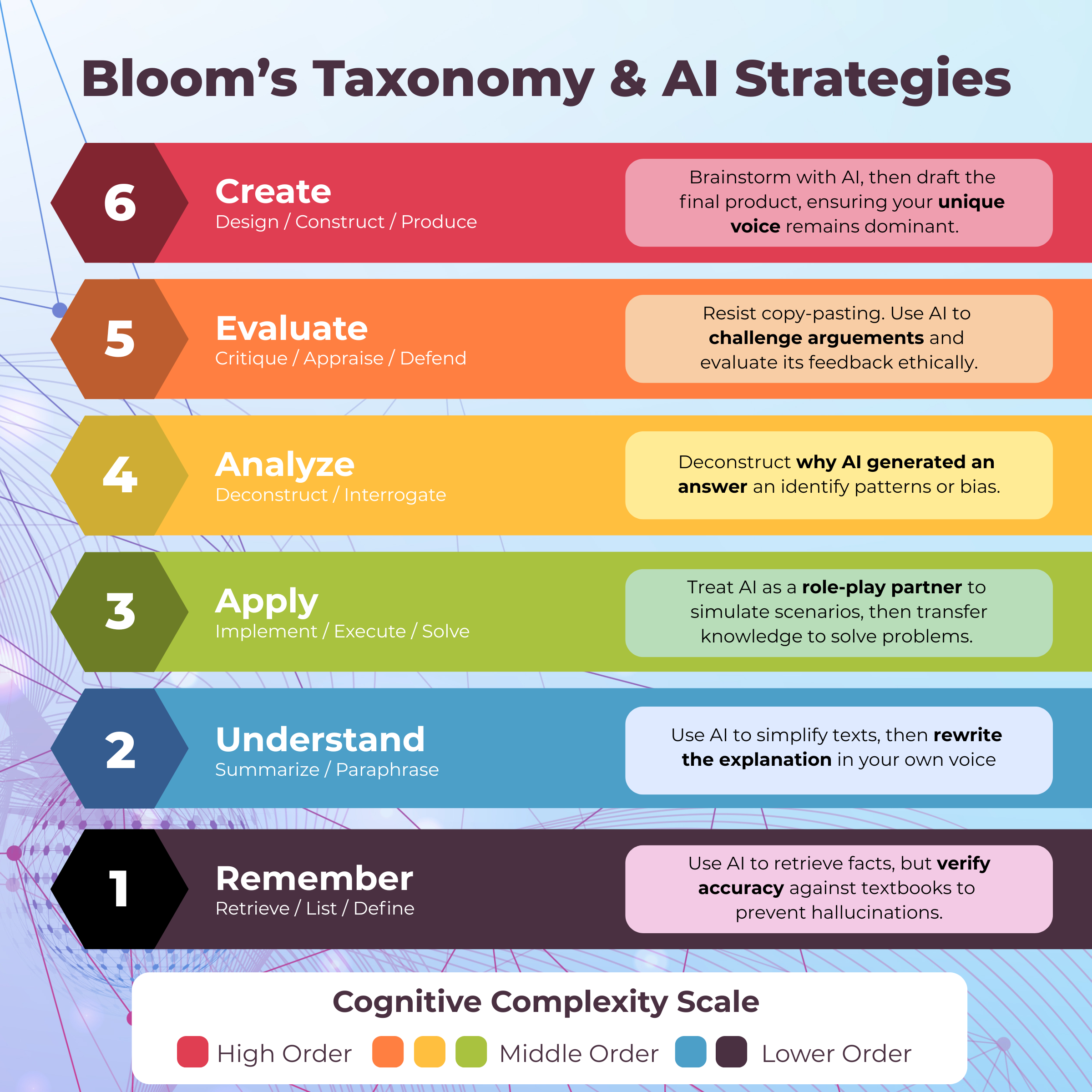
When it comes to Large Language Models (LLMs) and other AI tools, this educational framework becomes indispensable. It allows educators and instructional designers to strategically deploy AI to support specific cognitive processes, ensuring that technology serves as an accelerator for learning, rather than a crutch that bypasses critical thinking. Imagine a visual guide, perfect for professional development sessions, classroom posters, or digital assignments, that outlines practical strategies for using AI responsibly at each stage of learning. This isn’t just about teaching students to prompt an AI; it’s about teaching them when, how, and why to engage with AI as a robust learning tool, fostering genuine understanding and intellectual growth. Five Star Technology Solutions integrates Bloom’s Taxonomy into all our AI readiness programs, providing actionable guidance for teachers.
AI as a Catalyst Across Bloom’s Levels: Building Foundational Skills
AI acts as a powerful catalyst across Bloom’s foundational levels by transforming basic cognitive tasks like remembering and understanding into dynamic opportunities for deeper engagement and critical reflection. It enhances information retrieval, explanation, and interpretation, laying a solid groundwork for higher-order thinking skills when applied thoughtfully. Our Five Star Technology Solutions framework helps educators deploy AI effectively at these crucial initial stages.
Remembering: AI for Information Retrieval and Recall
AI significantly enhances the “Remembering” level of Bloom’s Taxonomy by facilitating rapid information retrieval and recall, such as generating flashcards or summarizing complex texts. However, its educational value lies in teaching students to critically verify AI-generated content against reliable sources, moving beyond passive consumption to active validation. This foundational level involves recalling facts, terms, basic concepts, and answers.
-
AI Strategy: Utilize AI to generate flashcards, concise summaries of complex texts, or quick definitions. For example, a student might prompt an LLM: “Summarize the main points of the Gettysburg Address for a 7th grader.” or “Define ‘photosynthesis’ and list its key components.” This supports initial exposure to concepts.
-
Key Pedagogical Strategy: The crucial next step, emphasized by Five Star Technology Solutions, is to teach students to cross-reference AI output with multiple reliable sources, identify potential biases or inaccuracies, and articulate the information in their own words. This moves them beyond mere recall to active information vetting and digital literacy.
Understanding: AI for Explanation and Interpretation
For the “Understanding” level, AI serves as an effective tool for explanation and interpretation by simplifying complex concepts, offering analogies, or rephrasing difficult passages. Educators can leverage AI to provide diverse perspectives, but critically, students must evaluate the clarity and accuracy of AI’s output to deepen their comprehension. This stage involves comprehending the meaning of information, explaining ideas, and interpreting data.
-
AI Strategy: Students can ask AI to explain concepts in simpler terms, provide relevant analogies, or rephrase difficult academic passages. Prompts could include: “Explain the concept of supply and demand using a real-world example.” or “What is the main idea of this scientific article in five sentences?”
-
Key Pedagogical Strategy: Encourage students to critically evaluate AI’s explanations. Is it clear? Is it accurate? Can they elaborate on it further using their own words or apply it to a new scenario? This iterative process strengthens their grasp of the subject matter and hones their ability to discern quality information, a skill fostered through Five Star Technology Solutions‘ curriculum.
Elevating Cognitive Processes: AI for Higher-Order Thinking
Beyond foundational learning, AI significantly enhances higher-order cognitive processes by providing dynamic tools for application, analysis, evaluation, and creative output. It allows students to engage with complex challenges, synthesize information, and develop original ideas in ways previously unimaginable. Five Star Technology Solutions helps educators design learning experiences that leverage AI to push students toward peak intellectual performance.
Applying: AI for Problem-Solving and Scenario Simulation
For “Applying,” AI provides practical scenarios and problem-solving opportunities, allowing students to use learned concepts in new situations, translating theoretical knowledge into practical skills. Students can simulate experiments, generate code examples, or design solutions to hypothetical challenges, moving concepts from abstract to concrete. This level focuses on using information in new situations.
-
AI Strategy: Use AI to generate realistic case studies, create interactive simulations, or propose solutions to real-world problems. Example prompts: “Design a simple Python script to calculate the area of a circle, prompting the user for input.” or “Given this historical event, predict three potential alternative outcomes.”
-
Key Pedagogical Strategy: Students should evaluate AI’s suggested solutions, adapt them to specific constraints, and critically explain their reasoning. This promotes metacognition and allows for iterative refinement, essential skills taught in Five Star Technology Solutions‘ AI literacy workshops.
Analyzing: AI for Pattern Identification and Critical Dissection
“Analyzing” benefits from AI’s ability to identify patterns, break down complex information into its component parts, and facilitate detailed comparisons, fostering deeper insights. Students can use AI to categorize data, dissect arguments, or compare different perspectives on a topic, moving beyond surface-level understanding to infer relationships and structures. This involves breaking information into parts to explore understandings and relationships.
-
AI Strategy: Leverage AI to categorize research data, identify themes in a text, or compare arguments from multiple sources. Example prompts: “Analyze the arguments for and against renewable energy, highlighting common themes.” or “Break down the structure of this scientific paper, identifying its hypothesis, methods, and conclusions.”
-
Key Pedagogical Strategy: Students must critically evaluate AI’s analysis, identify potential biases, and form independent conclusions. This involves questioning AI’s interpretations and using its output as a starting point for deeper human insight, a core principle advocated by Five Star Technology Solutions.
Evaluating: AI for Critical Assessment and Judgment
At the “Evaluating” level, AI supports critical assessment of information, evidence, and arguments, enabling students to form reasoned judgments based on established criteria. Students can prompt AI to generate counter-arguments, compare various solutions, or assess the reliability of sources, honing their skills in discernment and evidence-based decision-making. This involves making judgments based on criteria and standards.
-
AI Strategy: Use AI to generate multiple perspectives on a controversial topic, create rubrics for self-assessment, or simulate debates. Example prompts: “Evaluate the strengths and weaknesses of this proposed solution to urban traffic congestion.” or “Compare these two historical interpretations of the causes of World War I, highlighting their biases.”
-
Key Pedagogical Strategy: Students should justify their personal evaluations against AI’s output, clearly articulating their criteria and evidence. This fosters independent critical thinking and the ability to defend one’s conclusions, skills refined through instructional strategies provided by Five Star Technology Solutions.
Creating: AI for Generating Innovation and Original Work
“Creating” harnesses AI as a collaborative partner for generating new ideas, designing original works, and producing innovative content, pushing the boundaries of student expression. Students can use AI for brainstorming, drafting creative writing, developing presentations, or generating multimedia elements, transforming initial concepts into tangible, novel outcomes. This is the highest level, involving producing new or original work.
-
AI Strategy: Leverage AI for brainstorming initial ideas, drafting outlines for essays, generating visual concepts, or composing musical snippets. Example prompts: “Brainstorm ideas for a sustainable city design project.” or “Write a short story about a future where AI handles all daily tasks, focusing on the human element.”
-
Key Pedagogical Strategy: Students must iterate on AI’s suggestions, inject their unique perspectives, and refine outputs to reflect their own voice and intent. Responsible attribution of AI contributions is also paramount. Five Star Technology Solutions emphasizes the development of human creativity alongside AI collaboration.
FAQ: Integrating AI and Bloom’s Taxonomy in the Classroom
- Q: How can AI support higher-order thinking skills effectively?
- A: AI supports higher-order thinking by providing tools for complex problem-solving, data analysis, scenario evaluation, and creative generation. For instance, AI can help students analyze large datasets, simulate outcomes for decision-making, or act as a brainstorming partner for innovative projects, moving beyond basic recall to deep cognitive engagement.
- Q: Is using AI for learning considered cheating?
- A: No, using AI for learning is not inherently cheating when integrated thoughtfully and ethically, with clear guidelines from educators. The focus shifts from preventing AI use to teaching students how to use AI responsibly—as a tool for research, ideation, or analysis—while ensuring they understand, verify, and attribute its output, fostering genuine learning outcomes.
- Q: What are the biggest challenges for educators integrating AI into Bloom’s Taxonomy?
- A: Key challenges for educators integrating AI include developing effective pedagogical strategies, ensuring equitable access to technology, training teachers on responsible AI use, and establishing clear academic integrity policies. Managing the dynamic nature of AI tools and assessing genuine student learning amidst AI assistance also pose significant hurdles. Five Star Technology Solutions offers targeted professional development to address these specific challenges.
- Q: How can Five Star Technology Solutions assist with AI integration in education?
- A: Five Star Technology Solutions provides comprehensive support for AI integration in education through professional development workshops, customized curriculum development, and access to curated AI tools aligned with Bloom’s Taxonomy. We offer practical strategies for responsible AI use, ethical guidelines, and ongoing consultancy to help school districts and educators successfully navigate the evolving landscape of AI-powered learning environments.
Harnessing AI’s Potential for Educational Transformation
The strategic integration of AI, guided by robust frameworks like Bloom’s Taxonomy, is not just about adopting new technology; it’s about transforming the educational experience to foster deeper learning, critical thinking, and responsible digital citizenship. By following these pedagogical strategies, educators can confidently leverage AI to support every level of cognitive development, preparing students not just for tests, but for a future where AI proficiency is paramount.
Five Star Technology Solutions is committed to empowering educators with the knowledge, tools, and support necessary to lead this transformation. From professional development to curriculum design, we ensure that AI becomes a powerful ally in your mission to cultivate thoughtful, engaged, and highly capable learners. Partner with us to unlock the full potential of AI in your classroom and elevate student success to new heights.